
Houston County Criminal Court Cases
Houston County uses several courts, and the charge level controls the route. Superior Court has exclusive felony trial jurisdiction. Its criminal division records indictments, accusations when proper, motions, orders, pleas, verdicts, and sentences. State Court hears misdemeanors such as battery, simple battery, criminal trespass, and underage drinking, along with county ordinances, game-and-fish cases, and traffic matters assigned to it. Magistrate Court handles warrants, preliminary proceedings, bond functions, and other matters within its statutory power. Warner Robins, Perry, and Centerville municipal courts keep their own city citation, ordinance, and traffic files.
The clerk is the custodian, not the arresting officer or jail. A booking charge may never become a filed count. A prosecutor can amend or decline it, and a grand jury may return a true bill or no bill. That is why a Houston County criminal court case answers a different question than an arrest entry. The court file shows what was prosecuted and what happened to each count.
The Superior Court Clerk page shows the office that maintains felony filings.
That official page is the sound route for current clerk contacts, the criminal search, and copy terms.
Houston County Benchmark Docket
Houston County's public criminal search runs through Benchmark. The county announced a major change in November 2025: Superior and State Courts launched Pioneer Technology's consolidated Benchmark case-management and e-filing system on November 12, and PeachCourt stopped accepting Houston filings after November 28. Old saved instructions can now lead to the wrong place. Public metadata may be searchable without an account, while document access or e-filing functions can require registration, payment, or a direct clerk request.
Use the complete case number when possible. Otherwise, combine surname, given name, and a filing range. Similar names are not proof of identity. Compare the court, filing date, charge, and other available details before relying on a match.
The official Houston Benchmark search displays the current case-search entry.
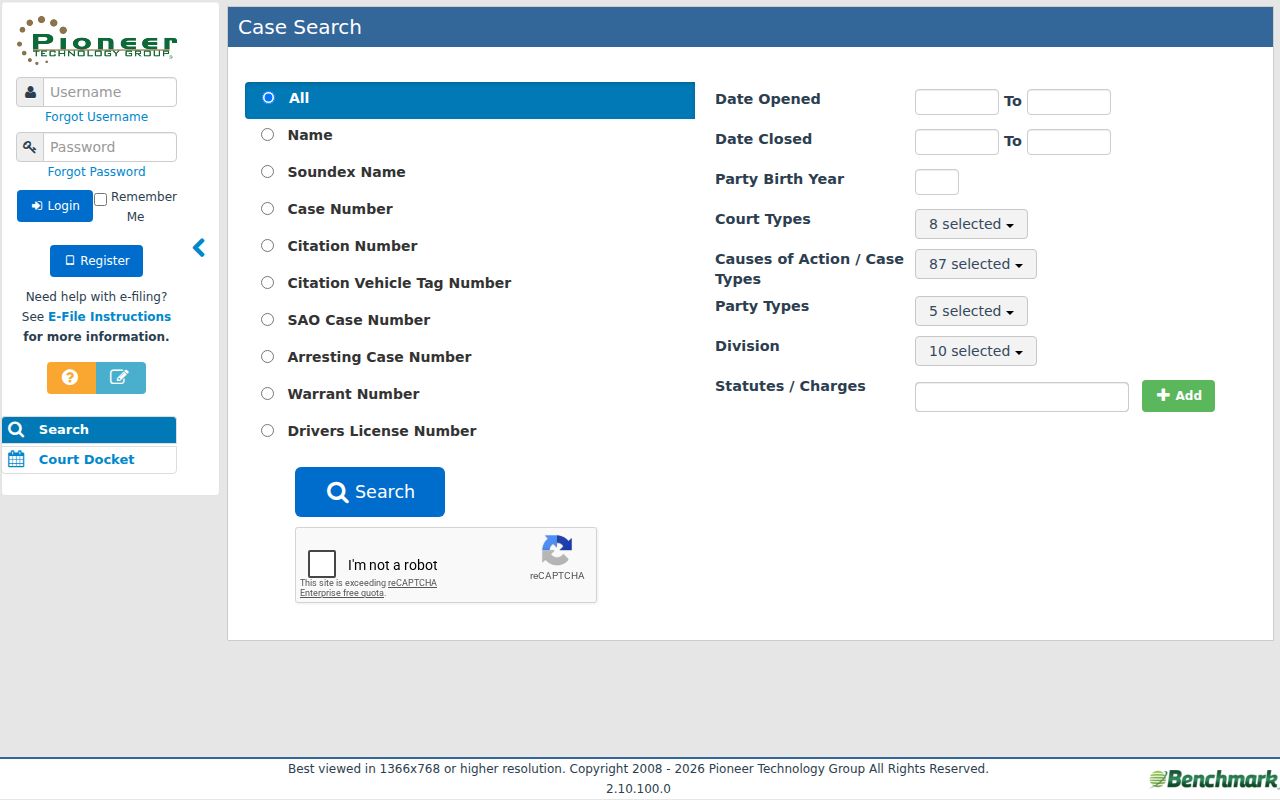
The screen confirms why court selection and narrow search terms matter before opening a docket.
Searching Houston County Case Records
A disciplined search prevents a city citation from being mistaken for a county felony file. Begin with the event and likely charge level, then use identifiers from a citation, bond paper, or prior clerk notice. When the public view omits an attachment, do not assume the paper is confidential. It may be nondigitized, account-gated, or available only by request.
- Select the Superior or State Court context that fits the filed charge.
- Search by the full case number, or use legal surname and given name.
- Add a filing range, middle name, case type, or status when the controls allow it.
- Open the docket and read every count, event, and disposition separately.
- Request public images or a certified disposition from the proper clerk.
| Benchmark field | Type | Status | Best use |
|---|---|---|---|
| Court/Location | Dropdown | Unspecified | Choose Superior or State context |
| Search Type | Tab/dropdown | Unspecified | Switch between name and case number |
| Last Name | Text | Unspecified | Enter the legal surname |
| First/Middle Name | Text | Optional or unspecified | Narrow common-name results |
| Case Number | Text | Unspecified | Use the full clerk number |
| Filing Date | Date range | Optional or unspecified | Limit broad results |
| Case Type/Status | Dropdown | Optional or unspecified | Filter where the module exposes it |
Houston County Court Jurisdiction
The venue list is more than a directory. It tells a reader where a record begins and why the same name may produce no result in another system. A felony indictment belongs in Superior Court. A county misdemeanor or assigned traffic prosecution belongs in State Court. A city ordinance case can stay at the city level. Magistrate records may document a warrant or early hearing without becoming the final trial docket.
| Venue | Criminal scope | Record route |
|---|---|---|
| Houston Superior Court | Felonies, pleas, trials, sentences | Benchmark and Superior Court Clerk |
| Houston State Court | Misdemeanors, traffic, county ordinances, game and fish | State Court traffic/criminal search and clerk |
| Houston Magistrate Court | Warrants, bond and preliminary functions | Official Magistrate Court page |
| Municipal courts | City citations, ordinances, traffic | Warner Robins, Perry, or Centerville court |
The State Court misdemeanor clerk page identifies its local scope and disposition reporting role.
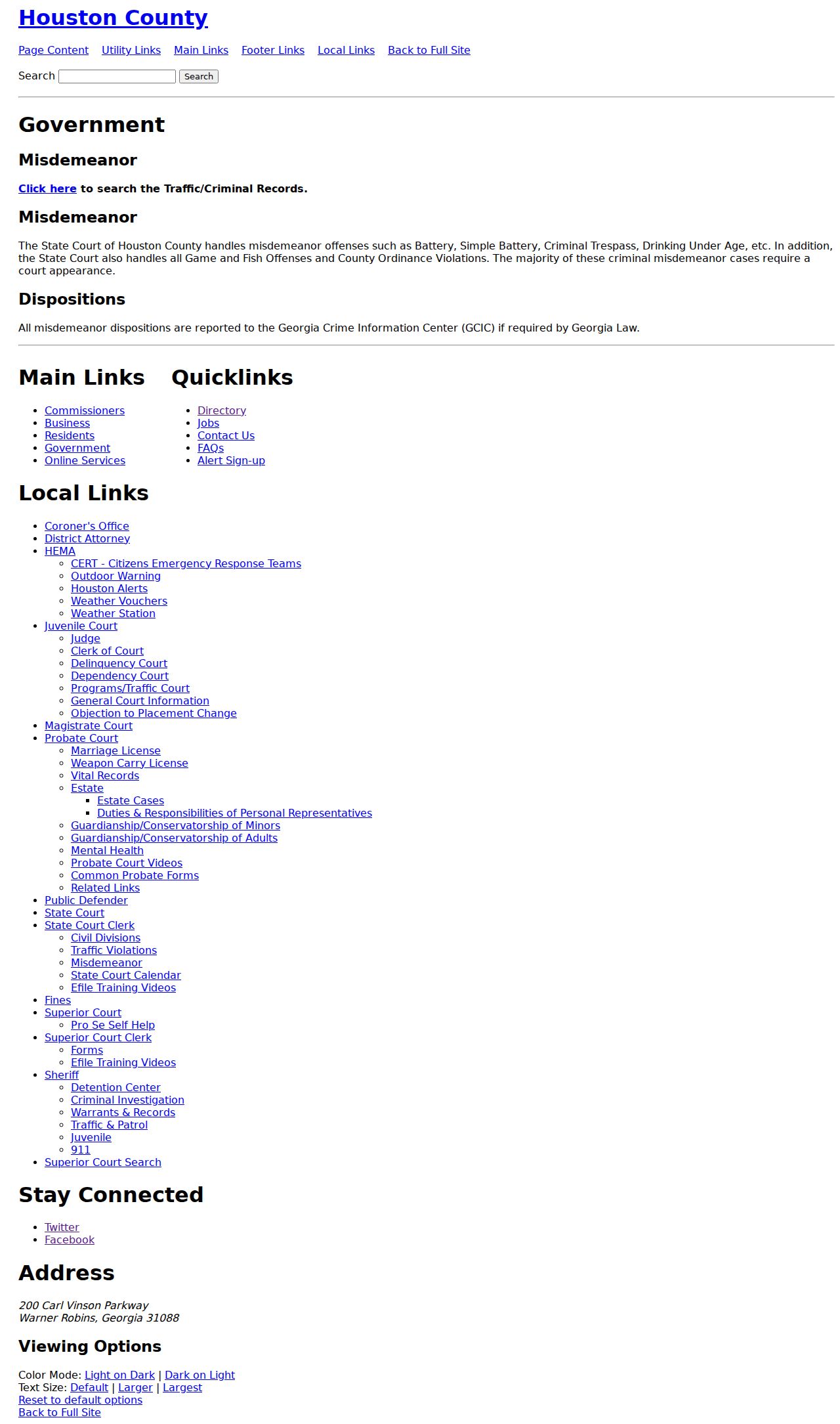
This court also reports qualifying misdemeanor dispositions to GCIC, which connects the local case result to Georgia's compiled history.
Inside a Houston County Case File
A Houston County criminal court file is organized around a case number and docket. It can show the formal charging paper, attorneys, judge, bond events, calendars, motions, pleas, and orders. Public document links appear only when the material is digitized and open. Complete dates of birth, Social Security numbers, protected victim or minor data, sealed filings, and restricted records should not appear in a public view.
| Case number and court | Identifies the local file, division, and venue. |
|---|---|
| Charging document | Shows the accusation or indictment and formal counts. |
| Docket entries | Lists dated filings, notices, motions, and court action. |
| Hearing dates | Shows calendars, arraignment, hearings, plea, or trial settings. |
| Disposition and judgment | Records the outcome of each count, not merely a case-wide label. |
| Sentence and conditions | Shows custody, probation, restitution, and other terms when public. |
A single case can contain a conviction on one count, a dismissal on another, and a nolle prosequi on a third. “Nolle prosequi” means the prosecutor formally chose not to continue that charge at that time. Read count by count.
Houston County Filing Changed
The 2025 move from PeachCourt to Benchmark affects more than lawyers. A self-represented person who needs electronic access must register and then email the proper clerk with a name and case number to be added. Registration alone does not attach a person to the case. The county said access should work by 5 p.m. on the next business day and advised checking after 48 hours.
There is a paper exception for incarcerated defendants and self-represented defendants without computer access. That exception helps preserve access, but it also means a fresh paper filing may not appear online at once. The docket remains useful for status. The clerk remains the source for the filed item.
The official Houston County Magistrate Court page helps route early criminal proceedings that do not belong in the felony trial file.
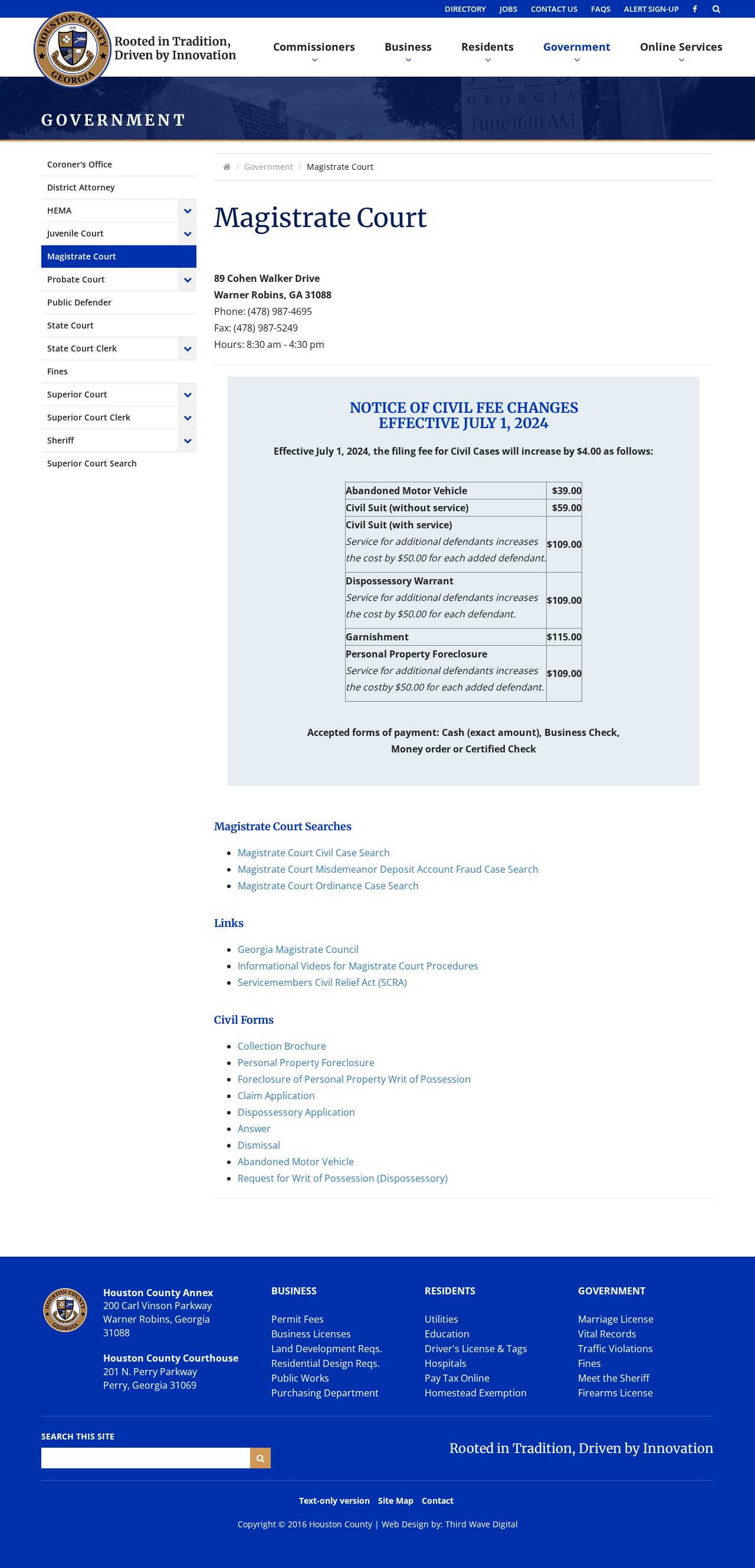
It provides the county source for warrants, bond matters, and statutory magistrate functions.
How a Criminal Case Moves
A Houston County case can start with an arrest or citation, but the court record takes shape after prosecutor review. A felony may proceed through grand jury indictment. Other charges may use an accusation. Arraignment is the hearing at which charges are addressed and a plea is entered. Discovery and motions follow as needed. A plea or trial resolves contested counts, then judgment and sentence create the disposition that the clerk or another justice agency reports to GCIC.
Case flow: Charges Filed › Arraignment › Pretrial › Plea or Trial › Disposition › Sentencing
Each step can add a new docket event. A calendar entry is not a result, and an open status does not predict guilt. For the separate custody trail that begins at booking, use the Houston County arrest lookup.
Houston County Disposition Terms
Short docket terms can change the meaning of a Houston County criminal case. A true bill means the grand jury found a sufficient basis to indict. A no bill means it declined the proposed indictment; it is not an acquittal after trial. Dismissal ends a count without a conviction. An acquittal is a not-guilty result after adjudication. A nolo contendere plea is a no-contest plea accepted without a factual admission for the case.
- Accusation
- A Georgia prosecutor's formal charging instrument commonly used outside a grand jury indictment.
- Capias or bench warrant
- A court command often issued after a failure to appear or comply.
- Disposition
- The result assigned to a case or individual count.
- First Offender
- A qualifying deferred-adjudication path with discharge benefits after successful completion.
The District Attorney decides what charges to pursue. The Houston Judicial Circuit District Attorney page identifies the local prosecution office.
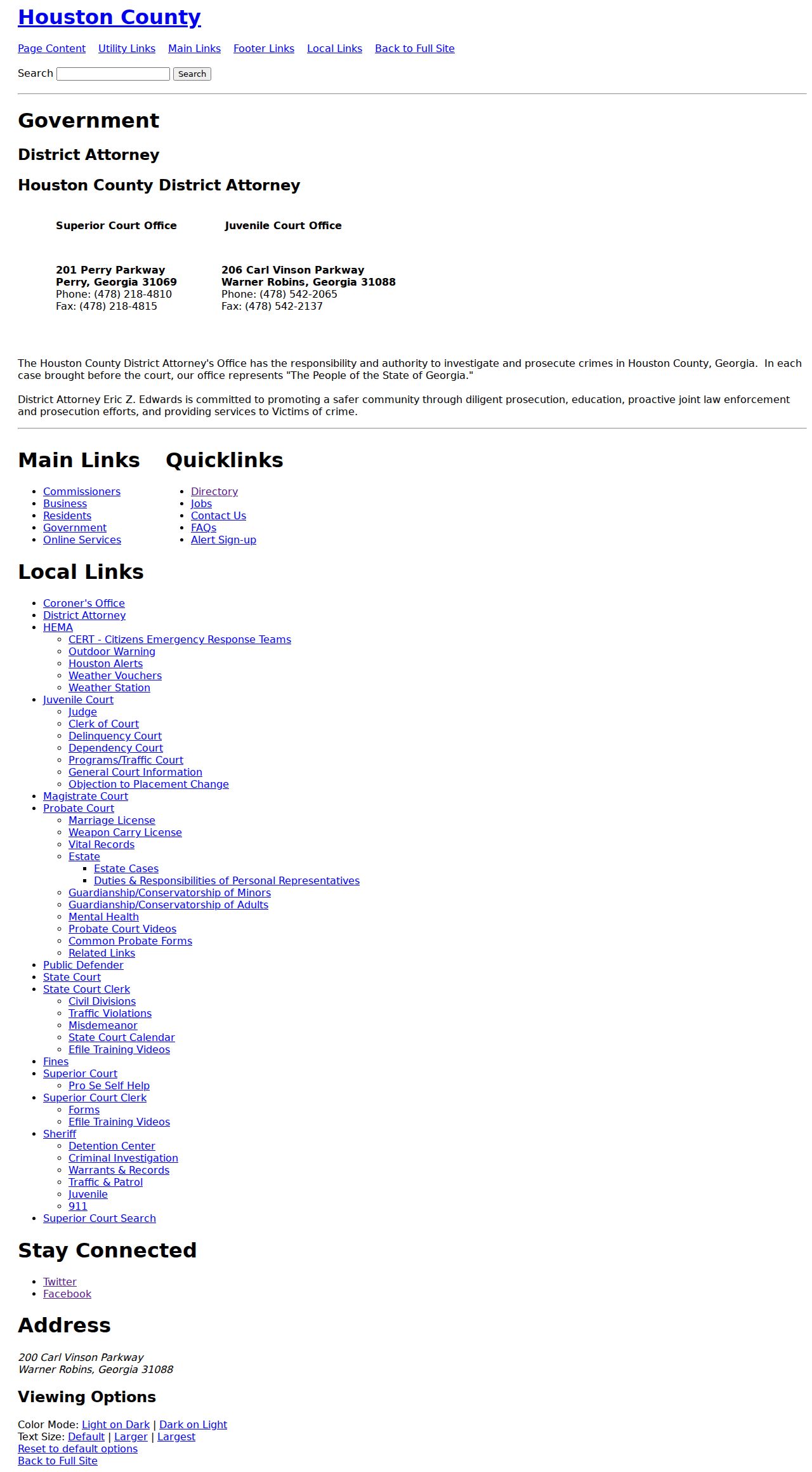
The prosecutor's role explains why intake charges can change before the clerk opens or updates the formal case.
Houston County Court Copies
The Superior Court Clerk's criminal counter is at the Houston County Judicial Complex, 201 North Perry Parkway, Perry, Georgia 31069. The criminal line is 478-218-4730, and posted hours are 8:30 a.m. to 5:00 p.m. A standard copy costs $1. A certified copy costs $2.50 for the first page and $0.50 for each added page. Certification is useful when the reader needs the clerk to attest that the copy is an official court record.
Ask for the exact item, such as the indictment, plea, sentencing order, or certified disposition. Include the court and full case number. Older, sealed, or nondigitized material may require staff review. If the public docket has no PDF, the missing image alone does not show that access is barred.
Indigent defense is separate from records custody. The Houston County Public Defender page documents the local defense office.
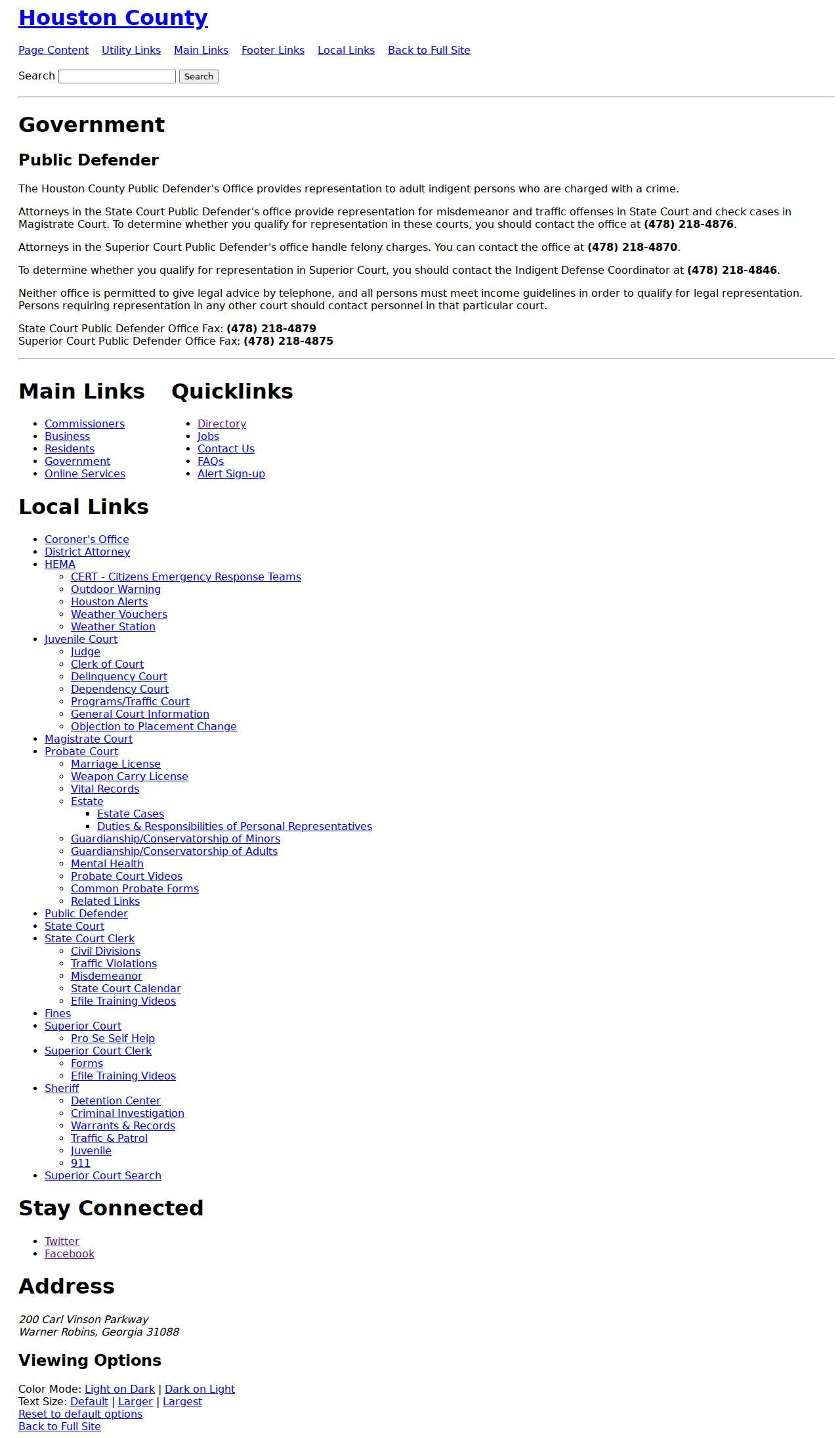
The image helps distinguish legal representation from the clerk service that supplies court records.
Case Record Access & Restrictions
Georgia court files are generally open, subject to sealing, confidentiality, and redaction rules. The Georgia Open Records Act governs many agency records, but a filed court document should be requested from its clerk. Juvenile matters, sealed cases, protected victim and minor data, account numbers, Social Security numbers, and some active investigative details may be withheld or masked. A public docket can therefore show an event without displaying its document.
If a Houston County docket is wrong, begin with the clerk that owns it. If GCIC later shows a missing or stale disposition, use official court proof when seeking a repository correction. One office cannot rewrite another office's source record. Record restriction limits public dissemination of a qualifying Georgia history, while a court sealing order is a related but distinct step under O.C.G.A. § 35-3-37.